


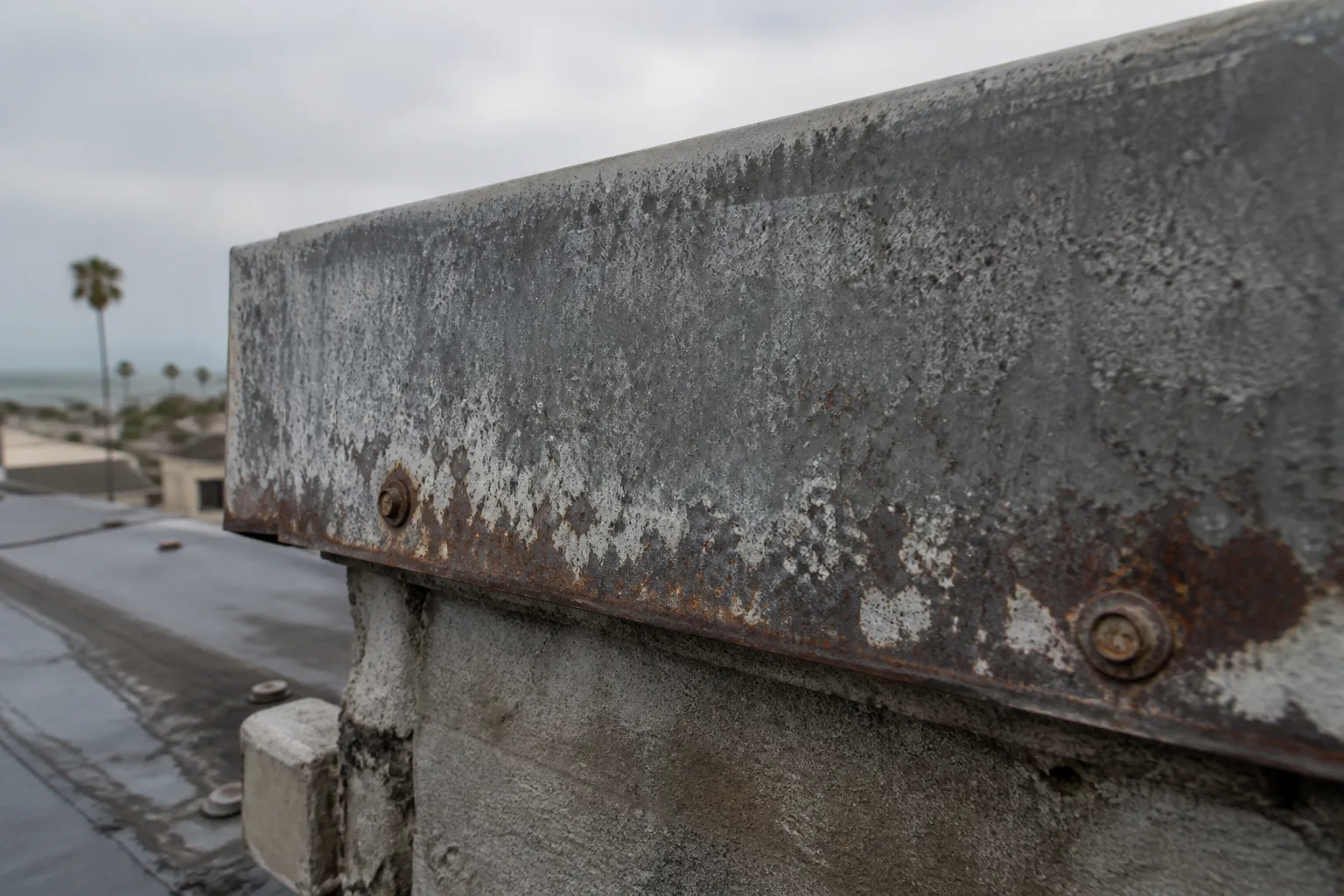
If you’ve ever pulled off a roof within a few miles of the ocean, you’ve seen what salt air does. Fasteners corroded to the point of crumbling. Flashing with white, powdery oxidation eating through from the underside. Metal components that should have lasted decades failing in under ten years. Roofs in Santa Monica, Venice, Pacific Palisades, Marina del Rey, and the western edges of Brentwood and Culver City operate in a fundamentally different environment than roofs even a few miles inland, and the material choices need to reflect that.
This isn’t about picking a prettier shingle. It’s about understanding the chemistry that salt-laden air introduces and specifying materials, fasteners, and assemblies that can handle it.
What salt air actually does to a roof
Ocean air carries chloride ions in the form of salt spray and fog. These ions are aggressive. They attack metals by breaking down protective oxide layers and accelerating electrochemical corrosion. The closer you are to the waterline, the higher the chloride concentration in the air, and the faster the damage.
Salt air roof corrosion doesn’t always announce itself. It can work slowly behind flashings, inside gutter seams, and around fastener heads where moisture gets trapped. By the time a leak shows up inside the building, the underlying metal component may already be too far gone for a simple repair.
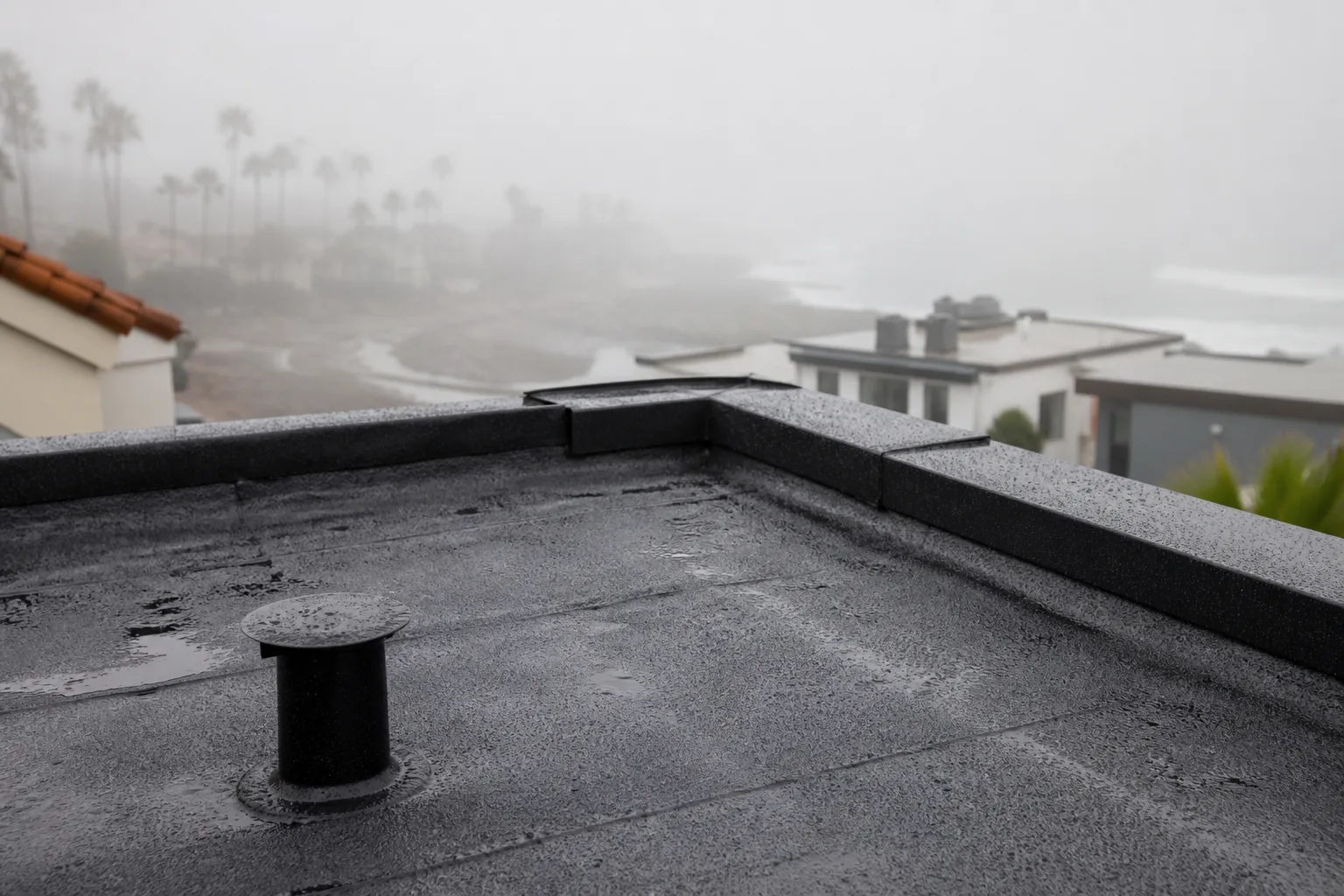
The marine layer compounds the problem. Along the Westside, that heavy coastal fog rolls in most mornings during the warmer months and sometimes hangs around well into midday. A roof that dries out by 8 a.m. in the San Fernando Valley may stay damp until noon in Venice. That extended moisture exposure gives chlorides more time to do their work.
Galvanic corrosion: the hidden killer
This is where a lot of coastal roof failures start, and it’s one of the most preventable mistakes in roofing.
Galvanic corrosion happens when two dissimilar metals are in direct contact in the presence of an electrolyte. Salt water (or salt-laden moisture from fog and marine air) is an excellent electrolyte. When you pair metals that are far apart on the galvanic series, the less noble metal corrodes at an accelerated rate. The more noble metal actually speeds up the destruction of its neighbor.
Common examples on a roof:
- Copper flashing fastened with steel or aluminum nails
- Aluminum drip edge in contact with copper gutters
- Steel fasteners driven through stainless steel flashing
- Galvanized steel components touching copper or brass fittings
Any of these pairings can cause problems inland, but near the coast the timeline compresses dramatically. What might take fifteen years to show up in Pasadena can show up in three or four years in Pacific Palisades.
The fix is straightforward: match your metals, or isolate them. If you’re using copper roofing materials or flashing, use copper or copper-compatible fasteners. If you’re running stainless steel, fasten with stainless steel. When isolation is needed, use non-conductive barriers or washers designed for the purpose. Your fastener and flashing metals should be a deliberate decision on a coastal job, not an afterthought.
Choosing coastal roofing materials that hold up
Not every roofing material responds to salt air the same way.
Tile: concrete and clay
Clay and concrete tile are naturally resistant to salt air corrosion because they aren’t metal. The tile itself holds up well. But the fasteners, flashings, and metal accessories under and around the tile are still vulnerable. On a coastal tile roof, the underlayment, flashing metals, and fastener spec matter just as much as the tile selection.
Metal roofing
Metal roofing can perform well near the coast, but the alloy and coating selection is critical. Some coated steel products carry manufacturer warranties that exclude or limit coverage in coastal zones. Before specifying a metal panel or standing seam system for a Westside job, confirm the manufacturer’s warranty terms for marine environments. Ask specifically about their distance-from-saltwater thresholds and what coatings they recommend. Don’t assume the standard product will be warrantied.
Asphalt shingles and composites
Asphalt shingles don’t corrode, which is an advantage. But they do face higher UV and wind stress closer to the water, and the marine layer’s persistent moisture can encourage algae growth. Algae-resistant shingle options are worth considering for any Westside project. Composite materials similarly resist salt corrosion but still depend on corrosion-resistant fasteners to stay put.
Slate and copper
Both are premium, long-lasting materials that handle coastal conditions extremely well. Copper develops a protective patina over time. Slate is stone. Neither corrodes in the conventional sense. Again, the supporting metals and fasteners must match the environment.
Underlayment and ventilation near the coast
The marine layer effect deserves its own attention when it comes to the roof assembly. A roof that stays damp longer needs:
- High-quality underlayment. Synthetic underlayment handles prolonged moisture exposure better than traditional organic felts. On coastal jobs, the underlayment is working harder, longer, and more often. Specify accordingly.
- Proper ventilation. Adequate intake and exhaust ventilation helps dry out the roof deck and attic space once the marine fog burns off. Poor ventilation traps moisture, which accelerates wood rot and can degrade fastener connections from below.
- Leak barriers at critical points. Valleys, eaves, penetrations, and anywhere water might pool or slow down should get self-adhering leak barrier, not just standard underlayment. This is good practice anywhere, but it’s especially important where the assembly stays wet for extended periods.
UV and wind: the other coastal factors
Proximity to the water means less obstruction between the roof and the sun. Fewer trees, fewer neighboring buildings, more direct and reflected UV. Roofing materials on exposed coastal properties take a heavier UV hit, which degrades asphalt faster, fades coatings sooner, and breaks down sealants and caulks more quickly.
Wind is the other variable. Coastal properties face higher average wind speeds and stronger gusts than sheltered inland neighborhoods. That affects shingle wind ratings, tile attachment methods, and how aggressively you need to fasten metal panels. Check local wind speed maps for the specific jobsite and specify products rated for those conditions. Permit and code requirements vary by jurisdiction, so confirm attachment schedules and wind ratings with the local building department.
Shorter maintenance intervals near the beach
A roof that gets inspected every two or three years inland should be looked at more often on the Westside. Salt deposits build up, flashings degrade faster, and small failures become big problems quickly in a marine environment. Property owners and facility managers with coastal buildings should work with a licensed roofing contractor to set an annual inspection schedule. Catching a corroded fastener or failed sealant joint early is far cheaper than dealing with water damage inside the building.
Frequently asked questions
Can I use standard galvanized fasteners on a coastal roof?
Standard galvanized fasteners corrode faster in salt air. Hot-dipped galvanized or stainless steel fasteners are a better choice. The right spec depends on the roofing material and the specific exposure. Check with the material manufacturer for their coastal fastener recommendations.
How far from the ocean does salt air affect roofing?
There’s no single cutoff. Salt concentration drops as you move inland, but it depends on prevailing winds, elevation, and local geography. Most manufacturers define a coastal zone in their warranty documents. Ask for that specification before you order.
Does the marine layer really matter for my roof?
Yes. Extended dampness accelerates corrosion, promotes biological growth like algae and moss, and keeps the roof deck wetter for longer. Good underlayment and ventilation design account for this.
Are there special code requirements for coastal roofing in Santa Monica or other Westside cities?
Requirements vary by city and can include specific wind load ratings, fire ratings, and energy code compliance under California Title 24. Always confirm with your local building department before finalizing a material spec.
Getting the right materials to your Westside jobsite
We stock the full range of roofing and waterproofing materials that coastal jobs demand, from corrosion-resistant fasteners and flashing to high-performance underlayments, tile, metal, and everything in between. We operate out of 112 W. Jefferson Blvd in Los Angeles and deliver to Westside jobsites with our custom fleet. Will-call pickup works too if you’d rather swing by.
If you’re speccing a coastal project and want to talk through material choices, give us a call or text at 213-747-1718. Se habla español. You can also email info@laroofingmaterials.com. We’re open Monday through Friday, 6 a.m. to 4 p.m., and Saturday 6:30 a.m. to noon. We’d rather spend ten minutes helping you get the right fastener spec now than hear about a callback later.