


Most commercial jobs do not go sideways because a crew forgot how to roof. They go sideways because material planning broke down. A membrane is backordered, tapered insulation is split across too many drops, the truck shows up late, or the quote looked fine until add-ons started stacking up. That is why experienced contractors do not judge commercial roofing suppliers by price alone. In Los Angeles, the better question is whether a supplier can help you keep the job moving without blowing up your bid.
For low-slope work especially, the supplier matters early. You are not just buying rolls, insulation, coatings, and accessories. You are buying availability, delivery coordination, will-call speed, and clear pricing that lets you estimate with confidence. If you are comparing commercial roofing suppliers for upcoming work, here is what is actually worth checking.
Start with availability, not the sales pitch
If a supplier cannot consistently support the system you bid, everything else is secondary. For commercial low-slope projects in Los Angeles, that usually means asking direct questions about built-up material, modified roofing, self-adhesive systems, rigid insulation, tapered roof systems, deck systems, felts, leak barriers, coatings, fasteners, sealants, and related accessories.
The key is not whether a yard can special-order something eventually. The key is whether they can support the sequence of the job. Commercial roofing supply is rarely one clean purchase order. It comes in phases. Dry-in materials may need to land first. Insulation and cover components may follow. Coatings, flashing metal, and accessories often hit later. A supplier that understands that flow can help prevent crews from standing around waiting for one missing piece.
Ask questions like these:
- Which commercial low-slope materials are stocked regularly versus ordered per job?
- Can they source full system components, not just the field material?
- How do they handle special orders and lead times?
- Can they support add-on quantities quickly if the field conditions change?
- Do they have enough product depth to cover multiple active jobs at once?
In Southern California, that last point matters more than people admit. A stretch of dry weather can compress schedules across the market. Suddenly everybody is trying to load the same week. A supplier with strong purchasing relationships and real inventory discipline is easier to work with than one that only looks good on paper.
If you want a sense of the categories a supplier should be able to support, review their commercial roofing materials offering before you send out quote requests.
Delivery is where supplier performance gets real
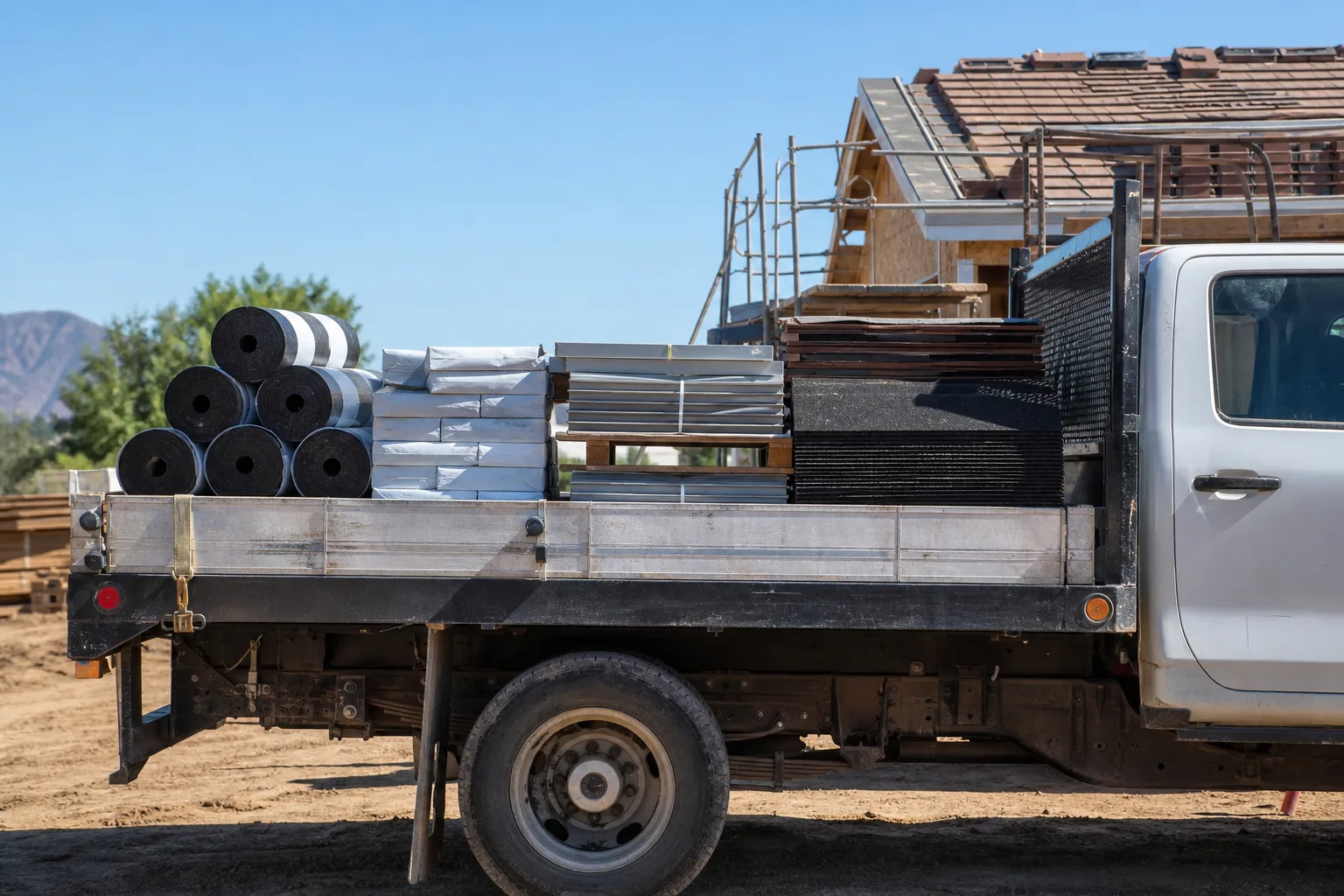
Commercial jobs in Los Angeles are won and lost on logistics. Tight sites, alley access, school schedules, traffic windows, occupied buildings, crane coordination, and limited laydown space all change what “delivery” actually means. Anyone can promise a truck. What you need is a supplier that can deliver the material where and when the project can actually receive it.
What to look for in jobsite fleet delivery
A good supplier should be able to talk through delivery details without a lot of drama. That includes staged drops, stocking plans, timing around other trades, and what happens if the site is not ready. If the answer to every delivery question is “we’ll see,” that is a warning sign.
From what we see at the yard, contractors usually care about a few practical things:
- Can the supplier schedule custom jobsite delivery instead of forcing one standard drop?
- Will the material arrive organized enough to keep the crew moving?
- Can they handle repeat deliveries for phased work?
- Do they communicate clearly if traffic, weather, or site conditions affect timing?
- Can they stock material in a way that reduces extra handling on site?
That matters in Los Angeles because jobs are rarely sitting on wide-open suburban lots with easy access. Downtown, mid-city, and infill sites punish sloppy delivery planning. Even on a straightforward tear-off and recover, a poorly timed truck can cost you labor, lift time, and patience with the GC.
L.A. Roofing Materials has built its business around will-call and custom fleet delivery for contractors, which is exactly the kind of service model many commercial crews need. Their fleet delivery information gives a clearer picture of how that side of supplier support works.
Will-call speed still matters
Not every material need belongs on a delivery ticket. Sometimes the foreman needs fasteners, sealant, a few extra rolls, or a detail item right now. That is where will-call tells you a lot about a supplier. If pickup is slow, disorganized, or always buried behind retail traffic, your crew pays for it.
Ask how orders are prepared, how early pickup starts, and whether your team can call or text ahead. A fast will-call counter is not glamorous, but it protects production.
Pricing that protects your bid is more than a low number
Every contractor wants competitive pricing. The problem is that the cheapest quote is not always the best quote. If pricing is unclear, inconsistent, or full of surprises, it is hard to estimate accurately and even harder to hold margin once the job starts.
When comparing roofing material suppliers, look at the structure behind the number:
- Are quotes detailed enough to show what is included?
- Is there consistency from estimate to fulfillment?
- How are freight, split drops, and special-order items handled?
- Can they help with job pricing before bid day instead of after award?
- Do they understand how commercial packages are assembled, so nothing obvious gets missed?
That last one is a big deal. A supplier that knows commercial work can often catch omissions before they become change-order headaches for you. They are not replacing your takeoff, but they can be a useful second set of eyes.
Independent suppliers sometimes get underestimated here. L.A. Roofing Materials is a NEMEON member, which matters because that cooperative buying power helps an independent supplier compete with national-chain pricing while staying local and family-owned. If you want background on that model, their page about NEMEON explains why buying power can translate into sharper contractor pricing.
That is the part many estimators care about most: can this supplier help keep the bid competitive without sacrificing service once the PO is cut?
Credit terms, paperwork, and the boring stuff that affects cash flow
Commercial work runs on paperwork almost as much as material. A supplier can have decent stock and still be hard to work with if account setup drags, billing is messy, or documentation is hard to get when accounting needs it.
Ask about credit accounts early, especially if your company is growing or taking on larger projects. You want to know how the application process works, how quickly it can be reviewed, and what support is available if a project needs documentation tied to submittals or safety records.
It also helps if the supplier has forms and support resources easy to access, not buried in a back-office maze. L.A. Roofing Materials keeps contractor account resources in one place on its contractor support page, which is useful if you are trying to get a relationship set up before a busy stretch.
None of this is flashy. It still affects whether your office likes working with the supplier, and whether your PMs can keep jobs moving without chasing paper.
Local knowledge matters on Los Angeles commercial roofs
Los Angeles is not a generic market. Heat, UV exposure, long dry periods, sudden seasonal rain, and wildfire concerns all shape commercial roofing decisions. So do local code and energy requirements. Depending on the building and jurisdiction, cool-roof requirements under the California Energy Commission’s Title 24 standards may come into play. Fire classification can matter too, especially where roof assemblies and local conditions demand it.
A supplier should not be guessing about those conversations. They should be able to help you source assemblies and components that fit the project requirements, while also reminding you to confirm details with the project documents and local building department. That is especially important because permit and code requirements can vary by jurisdiction.
This is also where local experience helps. A Los Angeles supplier that works with commercial contractors every day is more likely to understand staging limits, weather timing, and what products are commonly needed for this market. That is different from simply shipping material into it.
FAQ
Should a contractor choose a supplier mainly on price?
No. Price matters, but it is only one piece. If the supplier is slow on delivery, weak on stock, or vague on what is included, the cheaper number can cost more once the job starts.
What is the biggest red flag when comparing suppliers?
Unclear answers. If you ask about lead times, delivery windows, or what is stocked for commercial systems and you get a lot of soft language, pay attention. Good suppliers usually answer those questions pretty directly.
Does a local independent supplier really compete with larger chains?
Sometimes, yes. Buying power matters, and so does service. In this case, NEMEON membership gives L.A. Roofing Materials the purchasing strength to stay competitive while still offering local support, will-call, and custom delivery.
What should property owners take from this?
If you are hiring a licensed roofing contractor for a commercial project, ask who they source from and why. A strong supplier relationship usually shows up in smoother scheduling, cleaner material coordination, and fewer surprises.
What to ask before you open the account
Keep the conversation simple. Ask what commercial low-slope products are stocked, how delivery is handled, how quickly will-call orders can be turned, what pricing support is available before bid day, and how credit accounts work. Then pay attention to how they answer. You can learn a lot in ten minutes.
If you are sourcing for an upcoming job in Los Angeles, L.A. Roofing Materials supplies commercial roofing materials through will-call and custom jobsite delivery from 112 W. Jefferson Blvd, Los Angeles, CA 90007. You can call or text 213-747-1718, Se habla español, or email info@laroofingmaterials.com. Hours are Monday through Friday, 6am to 4pm, and Saturday, 6:30am to 12pm. If you want to talk through a material list, delivery plan, or pricing for a commercial roof, that is a good place to start.