


Before the first real Los Angeles storm, contractors usually tighten up the same list: the right gutter profile and size for the roof area, enough downspout capacity to move water fast, leaf protection after months of dry debris, and for low-slope buildings, scuppers and drainage parts that will not bottleneck when rain finally hits hard.
That matters more in Southern California than a lot of property owners expect. We can go a long stretch with dry weather, then get a short, heavy rain that finds every undersized outlet, clogged run, and bad discharge point. If the roof edge and drainage plan are wrong, water overshoots, backs up, stains walls, saturates fascia, and starts creating call-backs nobody wants.
For contractors, this is usually not about overbuilding. It is about ordering the parts that match the roof, the run length, and the way the building actually sheds water.

What contractors check first before ordering
The first pass is simple: roof shape, roof area draining to each eave, run length, outlet locations, and where the water can discharge once it leaves the roof. On a Los Angeles re-roof or gutters retrofit, that field check saves a lot of trouble later.
Most crews are looking at these questions:
- How much roof area feeds each gutter run?
- Is the roof steep enough to push water fast into one section?
- Are there valleys concentrating flow at one point?
- How many downspouts can the elevation handle without looking crowded or interfering with doors, walks, or equipment?
- Will debris from nearby trees overload the system after a long dry season?
- On commercial roofs, are the scuppers and conductor heads sized to keep up with sudden runoff?
In Los Angeles, the answer is often shaped by intense but intermittent storms. You may not need the same approach as a snow country roof, but you do need to respect concentrated runoff and clogged drainage paths.
Sizing K-style and half-round gutters the practical way
K-style and half-round systems both have their place. Contractors usually choose based on architectural style, fascia detail, expected flow, and what the owner is trying to accomplish visually.
K-style gutters
K-style gutters are common because they carry a good amount of water for their profile and sit neatly against many fascia conditions. For a lot of residential work in Los Angeles, they are the default choice when the goal is straightforward water control and a clean edge line.
They make sense when:
- The roof has long eave runs.
- Valleys dump a lot of water into specific sections.
- The owner wants a profile that blends into typical residential trim.
- The contractor needs solid capacity without going to a more specialized look.
Half-round gutters
Half-round gutters are often chosen for certain architectural styles, older homes, and projects where appearance matters as much as drainage. They can perform very well, but sizing and outlet planning matter because the profile handles water differently than K-style.
They are commonly ordered when:
- The home has a traditional or high-end design language.
- The roof edge detail suits brackets and a more exposed gutter profile.
- The contractor wants smoother debris wash-through in the right application.
Either profile can work. The mistake is choosing by appearance alone and ignoring the tributary roof area feeding each run. If a section takes the full load from a large slope or a valley, capacity has to come first.
Downspout planning is where a lot of jobs are won or lost
A gutter only works if the downspouts can empty it fast enough. That is where many drainage problems start. A run might look fine on paper, but if the outlets are too few, too small, or badly placed, water stacks up in the trough and spills over the front edge.
Most of the contractors we work with focus on placement as much as size. Good downspout planning usually means:
- Putting outlets near high-flow areas, especially below valleys.
- Breaking up long runs so water does not have to travel too far before dropping.
- Avoiding discharge points that dump onto entries, pedestrian paths, or low spots near the foundation.
- Making sure elbows, offsets, and wall conditions do not choke the flow.
On larger homes and commercial edges, adding capacity often means adding another downspout instead of forcing one outlet to do too much. That can be the cleaner fix.
For older buildings dealing with gutter replacement, this is also the time to correct bad legacy layout. If the original system always overflowed at one corner, replacing it with the same spacing usually repeats the problem.
Debris changes the sizing conversation in Los Angeles
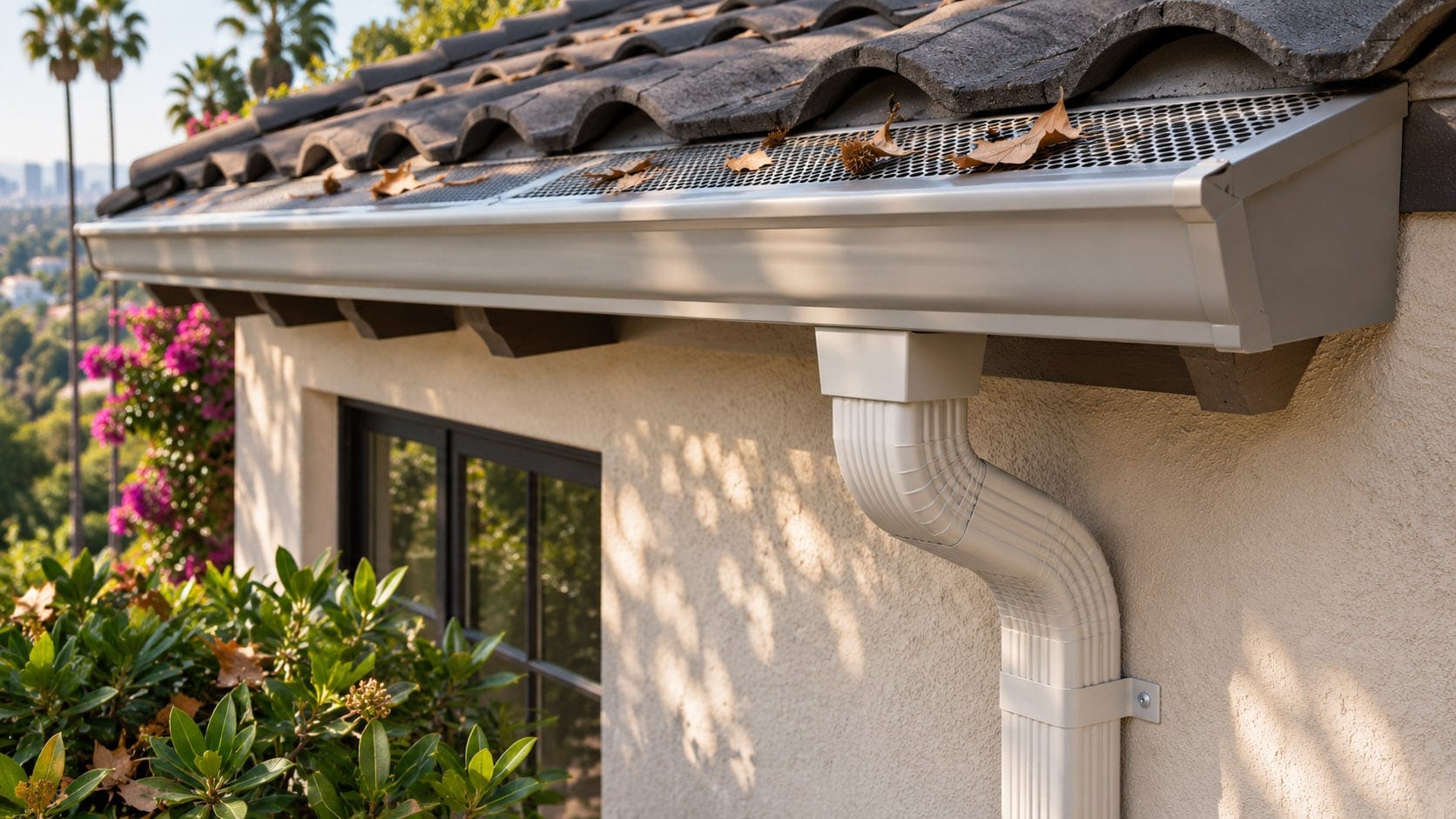
After a dry summer, roofs and valleys can be loaded with leaves, seed pods, dust, and granule wash. The first storm turns all of that into a blockage test. Even a properly sized gutter system can struggle if the outlets are packed with debris.
That is why leaf screens and related accessories tend to move before the rain starts, especially on homes with overhanging trees. They are not magic, and they do not remove the need for maintenance, but they can help limit the bigger clogs that shut down flow at the worst time.
Contractors usually look at leaf protection when:
- The house sits under mature trees.
- The owner has a history of overflow during first storms.
- The gutter run is hard to access for regular cleaning.
- The roof collects light, dry debris that blows into troughs all summer.
Pairing screens with proper slope, outlet sizing, and clean discharge paths gives the system a better chance once the weather turns.
Flat and low-slope commercial roofs need scuppers planned early
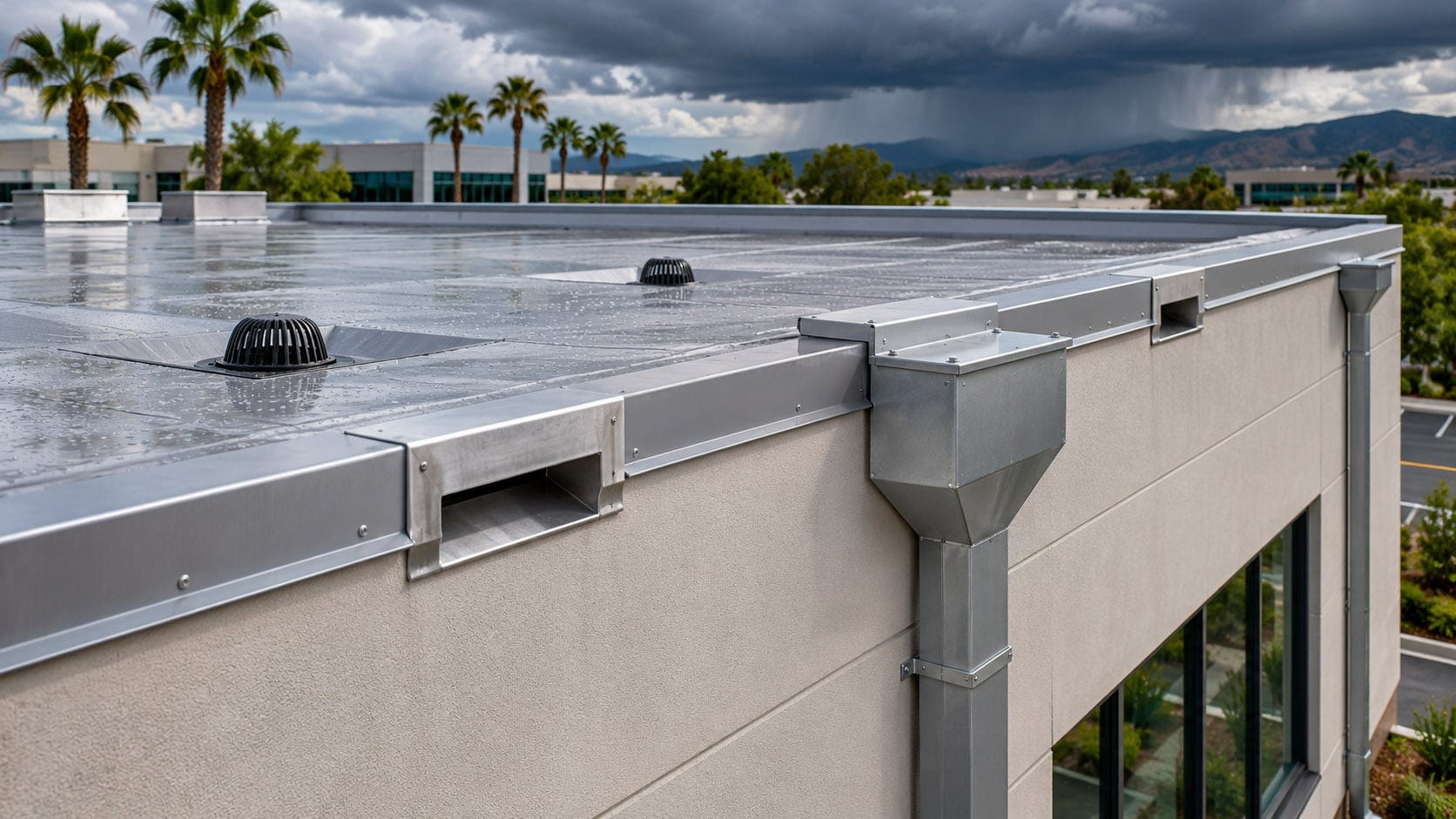
On commercial work, the conversation often shifts from hanging gutters to edge drainage, scuppers, conductor heads, and downspout takeoff points. A flat or low-slope roof in Los Angeles can look calm most of the year, then pond fast if drainage is undersized or obstructed.
Scuppers need to be treated like real drainage components, not just openings cut into a parapet. Their size, spacing, and placement should reflect the roof area draining to them, and the exterior components below them need to carry that water away without backing up.
If you are sourcing materials for these jobs, it helps to work from a complete drainage picture: membrane edge detail, metal flashing, scuppers, conductor heads if used, downspouts, and discharge. For related roof-edge and drainage materials, contractors can review available categories at Products & Services.
Local permit and code requirements vary by jurisdiction, so confirm drainage details with the project documents and the local building department before ordering.
What gets ordered before the first storm
The pre-rain order list is usually pretty consistent. Crews are trying to avoid delays once forecasts tighten up.
- K-style or half-round gutter sections sized to the roof and eave layout.
- Matching downspouts, elbows, outlets, and straps.
- End caps, miters, sealants, and fasteners.
- Leaf screens or guards where debris is a known issue.
- Flashing and edge metal if the roof line is being corrected at the same time.
- For commercial roofs, scuppers and related drainage metal.
On some jobs, the gutter package is tied to broader roof material pickup, especially when the contractor is already coordinating underlayment, flashing, ventilation, or other components. If you are lining up a full roof package, the contractor resources at Contractors are worth a look.
Why fast will-call matters in rain season
Once the first serious storm is in the forecast, nobody wants to lose half a day chasing missing parts. That is where a supply yard that understands roofing jobs makes a difference. Fast will-call lets crews pick up what they need without dragging out the schedule, and custom jobsite delivery helps when the order is too large or the site logistics are tight.
L.A. Roofing Materials has been supplying Southern California contractors since 1982 from 112 W. Jefferson Blvd, Los Angeles, CA 90007. The yard supports will-call and custom fleet delivery for roofing and drainage-related materials, which is exactly what crews need when rain prep turns urgent.
If you are sizing a residential gutter package, planning scuppers for a commercial roof, or trying to fix a problem area before the first storm, call or text 213-747-1718. Se habla español. You can also email info@laroofingmaterials.com or stop by Monday through Friday, 6am to 4pm, or Saturday, 6:30am to 12pm. If you want to set up an order or ask about material availability, the quickest next step is the contact page.